Tuesday, 13 April 2010

Qorikancha

Today was a good day. The weather was beautiful and everything went smoothly! My cultural experience of the day, Qorikancha, close to where Anastassja will soon be living, only cost me 10 soles and was top quality – I didn’t need a guide because everything was beautifully explained on clear wall panels in English and Spanish. This site was once the richest temple in the Inca empire – it’s name means “Golden Courtyard” in Quechua - and in the mid-15th century, when it was built, it was literally bedecked in this precious metal. The conquistadores destroyed the temple, looted its wealth and melted down the gold. However, the 6m-high perimeter wall, inside of which they went on to build the colonial church and convent of Santo Domingo, as well as some interior temples, dedicated to the moon and the sun, have withstood all the violent earthquakes in which the conquistadores' colonial buildings crumbled. Today’s site is a combination of Inca and colonial architecture, covered with a modern roof of glass and metal (top picture). I particularly appreciated the gardens and a representation in mounded grass of the Inca trilogy – the condor, the puma and the snake – (middle picture) but I doubt that this dates from Inca times. The colonial artwork was very well presented and in perfect condition and it was interesting to see how post-conquest artists of the so-called Cusco school sought to make religious figures look more like the Inca people – a virgin Mary with black plaits for example.

Upstairs, there was an exhibition of contemporary Inca-inspired art – all a bit tortured to my tastes –  (picture below) but I guess it can’t be easy for artists to cope with both Inca and colonial blood running through their veins and reconcile the two…

After my “bain de culture”, I met Anastassja in town at “The Muse”, a trendy bar where we enjoyed an apéro and some guacamole before my 5km walk back to the family house (and she her evening class)!

The good guide and the bad guide


The Lonely Planet guide describes the Museo del Sitio de Qorikancha as “small, mangy and underground” with “sundry moth-bitten archaeological displays”. I can now confirm this evaluation, but as this visit was included on our “boleto turistico”, we went anyway. Guides always present themselves once you have entered an “attraction” and, up until now, depending on feeling and my mood, I have accepted or not. To this lady I said yes, after agreeing on the fee of 15 soles for a 20-minute visit. What she told us was interesting enough, but she was quite speedy – she didn’t wait for me to finish reading the English explanations on the exhibits before moving to the next. At the end of the visit I paid her with a 50-sole note (12.50 euros), which caused tremendous problems – she went off to seek change but came back 10 minutes later not having found any… I suggested she ask at the entrance but they only had 100-sole notes. I asked her name and said I would pass by and leave her fee at the entrance the next day – but that was not acceptable either. By now I was getting a bit fed up – she had a problem yet I was expected to solve it. In the end, Anastassja saved the day by running off to nearby Maximo Nivel, where she did her TEFL course, and changed the note there…Phew! The photo  (above) was taken just in front of the museum – I gave these ladies 1 sole before taking the photo and yet they pestered me for more afterwards. This constant hunger for money (although, of course, I understand why) is one of the very tiring aspects of Cusco.

Later on in the day, by myself, I decided to visit the Iglesia de la Compania de Jesus on the Plaza de Armas. The young guia who guided me was called Guido and he said his fee for a 15-minute visit was discretionary – i.e. I could pay him as I thought fit after the visit. I agreed. Well, he certainly restored my faith in guides – his visit was excellent – pedagogic and clear with lots of anecdotal information that you don’t find in the guide books. The church is well worth a visit– it so rivaled the splendour of the cathedral while it was being built in the late 1560s that the Archbishop of Cusco called in Pope Paul III to arbitrate, but by then it was too late – the church was finished. At the end of what ended up being a one-hour visit, Guido even offered to take a few pictures of me, from the choir with the Plaza de Armas behind me (photo above). As a fee, I gladly gave him a 20-sole note and he very gratefully thanked me for it… I realise this account of my experiences with guides may irritate, but surely the notion of value for money and service has its place in poor countries too – or have I become too Swiss? (One thing I should add maybe to give an idea of  "going rates" is that Anastassja is paid 20 soles an hour for the classes she teaches at respected institutions - this hourly rate includes her preparation time, which is probably another 30 minutes on average).

Centro Qosqo de Arte Nativo

We haven’t been out a great deal in the evenings because Anastassja teaches from 7-9pm every weekday evening at the Alliance Française, but Sunday was an exception – we went to see a live performance of Andean music and dance. Entry was included on our “boleto turistico”. The show was surprisingly good – lots of costume changes, attractive and energetic dancers of both sexes and a mixed audience of tourists and Peruvians – apparently the programme changes regularly, so people come back. This show really brought it home to me how out of place the Peruvian musicians to be found in the tunnels of the Paris metro are! And how much they must miss their beautiful Peru!

Sunday, 11 April 2010

Machu Picchu - Such a perfect day!


I’ll let the pictures do the talking, but just a few lines to describe what was an unforgettable day...

We set off at 4am by car, minibus, train and bus to reach the ancient mountain, 112 km from Cusco. I knew we were in for a good day when I saw the white peak of the 6,372m Ausangate, the highest mountain in southern Peru, just before dawn. As we got closer to our destination, I got my first glimpse of the lush jungle vegetation, which kept this ancient site hidden until 1911 … (My avocados would be happy here!) The Machu Picchu “machine” is very well-oiled but not nearly as unbearable as I had expected. Sure, there were tourists, but not as invasive as I had feared they would be and it is Machu Picchu itself which steals the show…  More vertical than horizontal, the site itself is breathtakingly beautiful and the man-made constructions – or what is left of them – are in perfect harmony with their environment. I think the Incas who lived here must have had it good… although the ruins of what was a prison and their unexplained departure suggest that all was not perfect in paradise… The return journey was somewhat epic: bus, train, minibus and minibus, with the last rally-driven section from Ollyantaytambo to Cusco to the sound of full-blast Bob with an upside-down Big Dipper in the sky above…. Increible! (And a big thank-you to Eddy Ponce of www.innovatravelperu.com for the smooth organisation of our day).

Friday, 9 April 2010

Salsa!

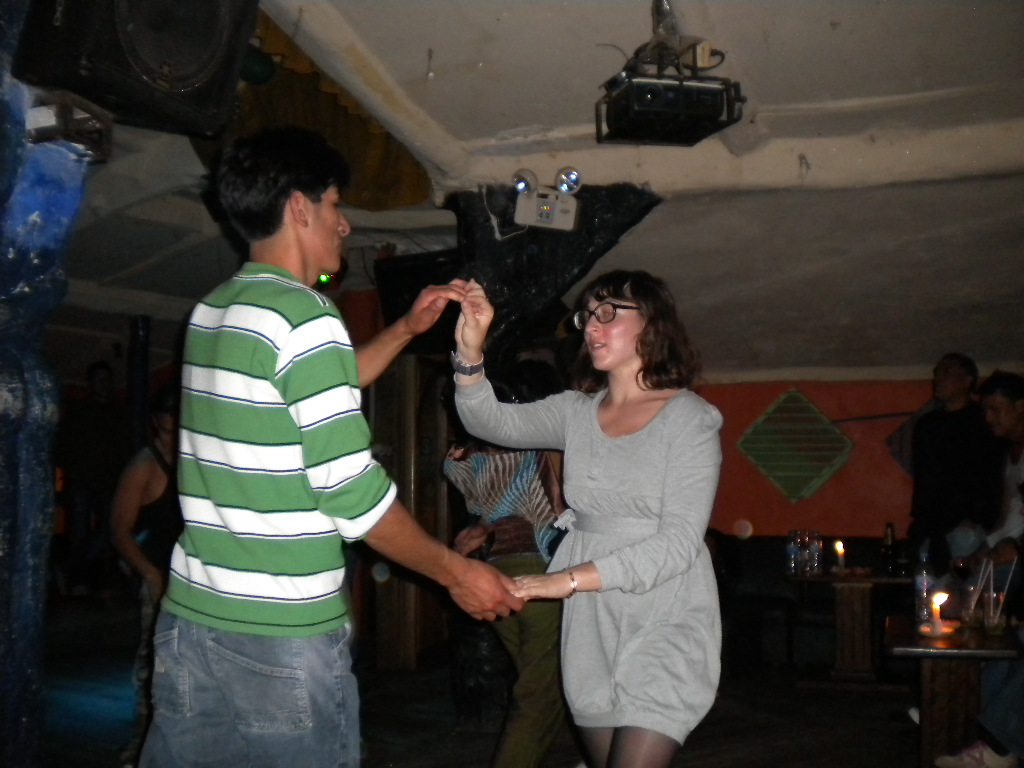
Last night, Anastassja initiated me to another dimension of Cusco life – salsa! After supper, we took a taxi into town, destination the “Mythology” in the Plaza de Armas. Anastassja, clearly a “habituée” ordered us a couple of Caipirinas and was soon whisked off to dance. From what I understood, those who can dance the salsa and want to just turn up between 9 and 11pm and dance! No need for a fixed partner – you find one there. This results in a joyous, fun atmosphere where everyone knows everyone and where age, nationality, shape, size or even level of dancing skill are irrelevant. At 11pm though the salsa stops, and more habitual disco-type music starts to play. It was a bit too early to go home so we moved on to another bar which was much more gringo-oriented – a big TV screening a football match, and a group of Peruvians playing the music they must suppose we want to hear – Hotel California – can you imagine! All a bit “ringard” as they say in French! I can understand why Anastassja has opted for salsa, that’s for sure!

The City Tour


Today we got four more holes punched in our “boleto turistico” for taking the inappropriately named “city tour” to Tambomachay, Pukapukara, Q’engo and Saqsaywaman (gringos cope with the pronunciation by calling it “sexy woman”!). These are all sites that are within a stone’s throw of Cusco. The weather was glorious and in addition to our driver, Reinaldo and Clevar, our guide, we were joined by Eddy, Clevar’s brother and Anastassja’s contact, in charge of the company they all work for. He was dressed somewhat incongruously in a suit and tie (which, unlike in Geneva, you don’t see here very often) as he had just attended a graduation ceremony at Cusco University!  
Here are a few comments on each of the sites, each of which served a different function in the Inca world. 
Tambomachay (top left) – this is an intimate site where Inca chiefs went to get away from it all and take the waters. The same fountains they used then still function today.   Pukapukara – (top right) this means “red fort” in Quechua and this site served the function of receiving and re-despatching produce from other Inca sites in the area. The views from here were particularly panoramic.  Q’engo – (left)  this had an even more ancient and slightly “spooky” feel to it. The rocks themselves are naturally occurring limestone and in some underground niches black llamas were ritually sacrificed to mark the summer and winter solstices.  Saqsaywaman – (bottom 3 left) no visit to Cusco is complete without discovering this site, just above the city. The Inca Pachacutec conceived the city of Cusco in the form of a puma (the Inca symbol of terrestrial life) and this site formed its head. Only 20% of the original Inca structure remains – the conquistadores pillaged the site for stones with which to build the cathedral and other buildings in the city, but were unable to transport the biggest stones, weighing up to 300 tons, and it those that remain today. A terrible battle was fought here in 1536 when Manco Inca challenged the Spanish cavalry led by Juan Pizarro, Francisco’s brother. The Incas lost by a hair’s breadth and retreated to Ollantaytambo, from where they continued to defy the invader.

Thursday, 8 April 2010

The day of severed heads


El Molino
Anastassja took me to this covered market where all the Cusqenos do their shopping. We visited the food part first and now I understand how she caught salmonella when she ate like the locals do. The meat part was the worst – flies everywhere, a particular smell, and the severed heads of goats and cows… luckily in the American-run Family House where Anastassja lives and I’m staying, South American exoticism only runs to fajitas and home-made pop corn!  The rest of the market sold everything from lipstick to mountain bikes – not forgetting pirated versions of all the latest films – Avatar seems to be a current favourite, projected on the enormous flat screens of all the CD/DVD stalls.
San Blas

San Blas is the “arty” part of town and I spent a very enjoyable late afternoon looking at the more up-market souvenirs on offer there. In one jewellery store, I got chatting
(in Spanish!) to the young artisan whose creations I was admiring and it turned out that he knows Anastassja! She was his teacher at Maximo Nivel, the language school where she recently passed her TEFL certificate! A small world! This encounter put me in a very good mood and I decided to add a bit of culture to the day’s menu by visiting the nearby Iglesia de San Blas. I’d never heard of this saint before (Saint Blaise in English) but apparently he was a 4th century Armenian Christian martyr who, like the poor Molino goats and cows, got his head cut off too… as pictures on the wall of the church confirmed. He is also the patron saint of throats… so let’s hope he does something for mine - but not too drastic please! This church is famous for its exquisitely carved pulpit, made from a single tree trunk. Perched above what is allegedly the finest example of colonial wood carving in the Americas is the skull of the craftsman whose legacy it is…. All in all a topping day!

peregrinations

"The visitor must have a fund of intelligent imagination and a blind eye for incongruities and then his peregrinations will be a remembered pleasure."

Wanderings in Wessex - An Exploration of the Southern Realm from Itchen to Otter